This is one of the best posts ever featured on Rich20Something…and alas, I did not write it. Sad face!
But I have managed to push aside my pride in order to bring you the absolute best content on the planet.
I’ll get straight to the point. A few months back, I was talking to my friend Kevin, and he was telling me about how he’d managed to write, edit AND publish a bestselling book in 6 months…with no prior experience. All while being deployed to a combat zone in Afghanistan.
The coolest part: He now makes over $1,000 of residual, recurring income every month from this book (it’s called Craft Cocktails at Home) and he’s agreed to tell us how he wrote the book, step-by-step — and how you can too.
This information is literally gold. I’d pay for it.
But instead, Kevin wants to pay YOU.
As if the information wasn’t enough — Kevin is also paying people HUNDREDS of dollars to write articles for his new site 75 to Go. What more could you ask for?
I’m really, really excited to share this with you.
Here’s Kevin:

Kevin - take it away.
*******
Hey guys, my name is Kevin Liu and one year ago today I had never made a penny writing. Fast forward one year and I:
- am the published author of an Amazon best-seller
- have earned over $10,000 in writing gigs
- earned up to $40/hour for my writing
- been asked by a well-known website to collaborate on a (second) book with them
And I did all of this while keeping up with my day job.
Sure, $10,000 in 10 months isn’t going to replace my salary anytime soon, but it’s pretty great as a side income, and, more importantly, it’s allowed me to pursue my entrepreneurial dreams while getting paid.
I’ve been working with Daniel through his Tribal Accelerator Program for the last few months. With his help, I’m launching my own startup this week.
In this post, I’ll give you the inside scoop on writing for money—including facts, figures, and resources. And at the very end I have a special invitation just for followers of Rich20Something
Let’s begin.
If you’re reading this blog, I assume you’re interested in making money through entrepreneurship. And that’s what gives you an advantage over other writers.
You have focus; your focus is making money.
Don’t get me wrong; it’s not that you only care about money. But, you understand how futile it is to write something that no one reads. To make money, you need an audience, and to build an audience, you need content that gets read.
Which leads me to my first tip -
Spend more time planning than you do writing.
Let’s look at an apples-to-apples comparison.
When I wrote my book, I knew it was going to be about cocktails and I knew I had a penchant for geeky conversations about ingredients and techniques, since I’d spent some time on food forums.
But, most people don’t frequent geeky food forums. Most people want simple, foolproof recipes.
How do I know this? because I ran a quick google keyword analysis:
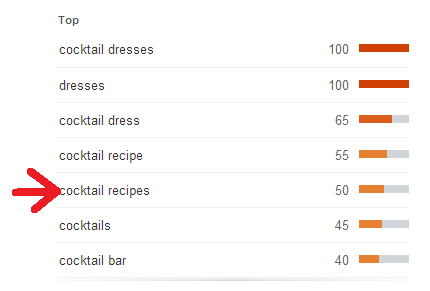
Note that although “cocktail recipe” appears fourth in this list, the combination of “cocktail recipe” an “cocktail recipes” actually tops the other keywords.
I also knew that I wanted the plural form of the word “cocktail” in my title. Here’s an Amazon search that demonstrates why:
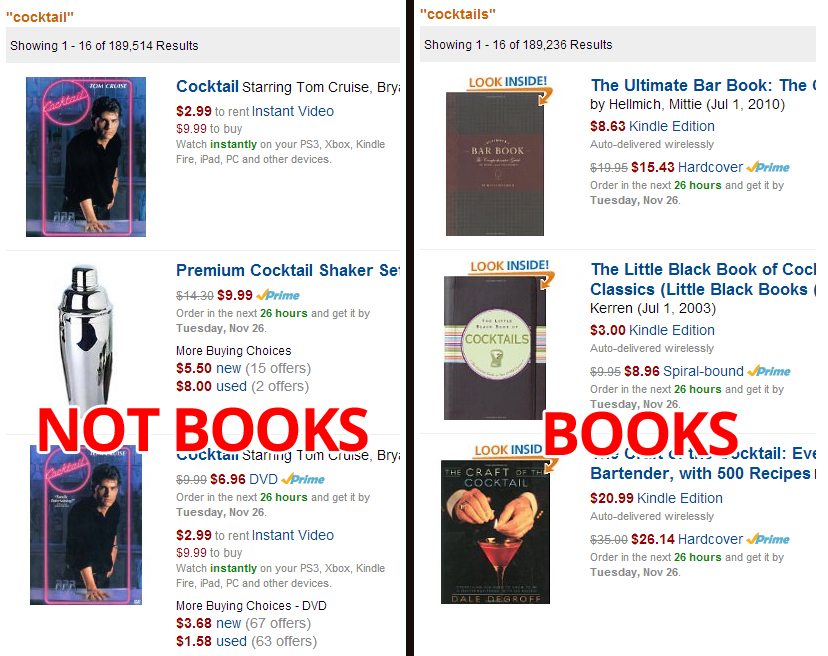
To figure out the rest of the title, I read through reviews on similar cocktail books and scanned the “most useful critical reviews” to find out what problems other books had that I could address. Got that tip from Tim Ferriss.
In the end, I settled on terms like “at home,” “craft,” and “classics,” because I thought that’s what my customer base would search for.
I geek terms, the word “cocktails” targeted the majority of my audience, while the rest of the words target the long tail of search results.
Did it work?
I’d say so: my book has stayed in the top 10 in the “cocktails & mixed drinks” category since publication and it regularly hits #1 in the “bartending” category in Kindle.
Here’s the counterexample:
This is a sciencey-cocktail book written by a well-known and established bartender. And here’s the New York Times post that promoted the book.
After the Times piece ran, the book rocketed to #1 in the cocktails & mixed drinks category. Yet, two weeks later, it wasn’t even in the top ten. Today, it’s sitting right around #50.
Since this book was “superior” to mine in every traditional respect, you begin to realize how much a difference a title makes to sales.
Remember that prior planning doesn’t only apply to writing books; I spend 75% of my article “writing” time writing and rewriting headlines, category titles, and excerpts. Here’s a good workflow for managing your time writing.
Got no cred? Use the Marsupial Method
If you haven’t read Daniel’s post on the marsupial method, go check it out. I’ll wait.
When I published my book, the only “platform” I had at the time was the 100 or so followers I had at a blog I was contributing to. At the time, we were getting about 500 hits a day, or in internet terms: “nothing.”
So rather than spend my time trying to build a following, I looked for:
(1) Where my potential customers were already spending their money
(2) Ways I could provide value to the people who were already selling to my potential customers.
My analysis:
(1) Where my potential customers were already spending their money
My potential readers are already following top-tier individual-writer food blogs.
(2) Ways I could provide value to the people who were already selling to my potential customers.
I can offer to include blog recipes in my book; the bloggers will then want to self-promote.
I reached out to the bloggers behind two popular cocktail recipes I had seen making the rounds on the blogosphere and asked them if they would be so kind to let me use their recipes (and promote their blogs, duh!) in my book. I still keep in touch with these guys because they love what they do and I genuinely took pleasure in working with them.
When it came time to promote the book, here are the two posts that my friends ran:
post #1 (43 comments)
post #2 (124 comments)
Those two posts got more buzz going than I could ever have achieved alone. In fact, here’s proof:
my promotional post on my blog (1 comment)
I used this technique in smaller ways with other blogs and friends-of-friends, but I think you get the idea.
Here are some no-B.S. ways to improve your writing.
I always promised myself that before I published my book, I would spend some time and really learn how to write. You know, read Strunk & White, keep a writing journal, etc.
I never did it.
And yet, here are some comments from people who’ve read and reviewed my writing:
- “a style that’s witty, light, clear, and amusing”
- “written in a very personable, humorous way”
- “It was easy to read and I found myself reading it almost non stop”
So am I just a naturally gifted writer? Or did I hire a ghostwriter to edit my copy?
Neither: I just wrote a lot of emails.
As 20-somethings, we write more in the form of emails, tweet, text messages, etc. than any generation in the history of the world. Is it any surprise that our brains have become programmed to respond best to simple, colloquial writing?
Or, as 3-time New York Times Bestseller Tim Ferriss recommends: “Write like you are talking to a close friend after two glasses of wine as if you’ve solved a problem that may help them.”
I’ll take that advice a step further. If you don’t think you can write a book, literally just start writing long emails to your friends about topics that interest you (and them as well, ideally). Make sure to proofread your work at least once. Then track which emails get a response. Now you know whether any of your writing is worth reading.
In fact, when my emails are good, I tend to simply copy and paste them into articles and use the text. [In fact, I do exactly that two sections down in this post]
And finally, if you haven’t discovered Copyblogger already, go download all of their free ebooks. Seriously, it’s like getting a free master’s degree in crafting compelling copy.
Even if you do everything right, writing can still pay terribly.
I’ve researched how to make money writing, and here’s the basic breakdown:
- On the very low end, you can find freelancers on Elance willing to write three 500-word articles per hour at a rate of less than $20 an hour. This used to be a way for new websites to generate traffic. Search algorithms have since adapted, but some websites still pay for this garbage.
- On the low end, expect to make $25 for a 500-word online article, or $0.05/word. A lot of reputable sites use this model. It boils down to a simple equation: can the hosting website make more money from ad revenue through a single article than it costs to pay the author to write it? Writing at this level can make you some money, but it’s hard work.
- In the middle, established web magazines and news agencies with a physical presence will pay $200 to $1000 for a roughly 1,000-word article, or $0.20-$1.00/word. These places will expect you to be able to interview sources and do your own copyediting. This is enough to make a living while wearing underwear in your basement, but nothing more.
- On the high end are well-established publications (think Wired, or National Geographic) that pay over $1/word. Articles can be as long as 10,000 words. Now we’re talking story pitches, expense accounts, and investigative journalism. Writing like this is probably going to be a career choice, not a side project or a means of passive income.
Here’s the takeaway from this section: there’s no easy way to earn money passively online unless you own the hosting website. Other article writing gigs can earn you anywhere from a few cents to a decent salary, but none of them are really passive.
Which is why self publishing is such a better alternative
Here are some excerpts from an email I sent to a friend who was interested in writing and publishing his own book. [remember what I said about re-using emails a few sections ago?]
Hey [friend]
Here’s a big mind-dump of stuff with regards to book writing/publishing etc.
Read this first
First off, if you haven’t dug through APE, I would seriously recommend it. Guy Kawasaki really touches on some good info.My few caveats to what he writes in APE:
- You can do a lot in Microsoft Word; learning Adobe InDesign may not be a priority
- He doesn’t really touch on iBooks distribution or Kindle Format 8. Worth thinking about.
- Amazon MatchBook has come out since APE, it changes Kindle pricing a bit
- Amazon’s KDP Select program (give Amazon exclusive rights to your book for 90 days) is less useful for generating sales now than when it first came out.
$$ Money
I didn’t have much of a platform when I did this [see above on the Marsupial Method], so I pretty much had to go with Amazon. You’ll obviously make much higher margins with a PDF option, though keep in mind that will keep you out of KDP select.[For more great info about selling PDF’s as information products from an established platform, see Chris Guillebeau’s phenomenal book The $100 Startup]
The money breakdown for my 250-page black and white book:
CreateSpace royalties: $1.99, list price of $9.80, Amazon generally reduces that to around $8.50
Kindle royalties: $1.97, list price of $2.99. (I toyed with changing the price to $3.99 and $4.99, but my total royalties actually dropped at those price points).
Google Play/iBooks: I talked to a girl who worked at google play and I get asked for a copy of iBooks once every two weeks or so, but I just never got around to it. And I don’t think people are legitimately buying books on Google Play. When people ask for an iBooks version, I just send them the PDF (for free).International Distribution: UK sales aren’t terrible, around 10% of US sales. The biggest markets I had trouble with were Singapore (where Amazon has no authority to distribute either paperback or kindle) and Canada, just because Canada’s Amazon website is so terrible. Hopefully that’s improved by now.
[I also chose to distribute solely through Amazon so that I could force accurate representation of my sales. Since it’s the only place to buy the book, every single sale helps bump up my sales rank and place my book higher in the charts.]
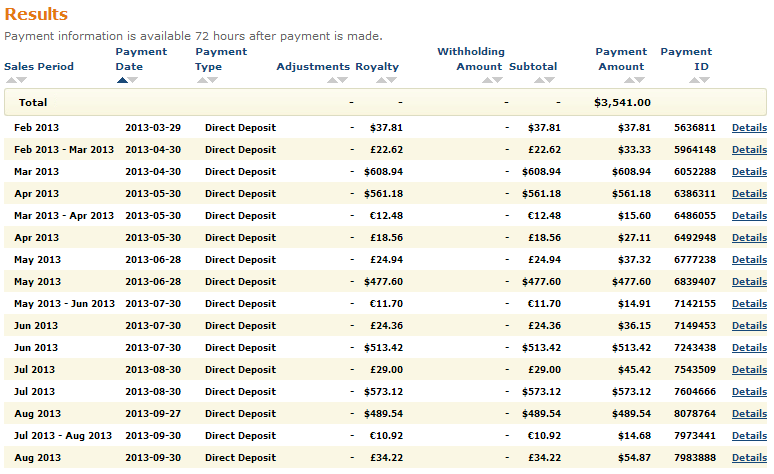
I average around 250 US sales per month on CreateSpace ($500) and something like 100 US Kindle sales per month ($200). When you add that up with the random International royalties (which are only paid out once you have I think $30 available) I’ll generally come out at $850-$950.
CreateSpace numbers below; Kindle doesn’t break it out by month so I’ve spared you the gory week-by-week details.
[notice how the sales number aren’t peaking and falling due to advertising campaigns or good press - they mostly hover around a set amount. that’s what you want for reliable passive income]
It’s hard to gauge how well your book will sell based off Amazon sales numbers alone, but I will say that the paperback has hovered around #6 in “Cocktails and Bartending” (peak at #3) and the Kindle version hovers at #3 in the equivalent Kindle-only category, with a peak at #1.
In total ranking, the paperback sits around #10,000, with a peak at #3,000. Kindle is currently at around #30,000 and I haven’t tracked its peak.
[See this rough chart of ranking-vs.-sales and calculate unit royalty to estimate your royalties.]
[Another tip: Before I started writing, I looked at the top 20 books in my target category (cocktails and mixed drinks) and estimated where my book could end up, based on my own estimation of my writing ability. I then looked at the overall ranking of the books in that range and estimated sales based on that.]
After writing my book, I actually thought I could help people with their own book projects, so I created a (now-defunct) website with simple Microsoft Word templates for all kinds of fiction and nonfiction books that could easily be converted to Kindle and CreateSpace. I even made a few hundred dollars on Fiverr helping people write books (that’s another post).
Anyway, here’s the link to all my templates and step-by-step guides to self publishing for free. Use at your own risk 😛
It’s still good to get some of your writing online… even if it doesn’t make you a whole lot of money.
Here are some good reasons:
- You enjoy the subject matter and writing for various publications gives you an excuse to talk to interesting people and learn new things. You can’t really replace that.
- Byline. It’s pretty standard to have your linkedin profile pop up when someone googles you. It’s much more powerful when this is what they see:
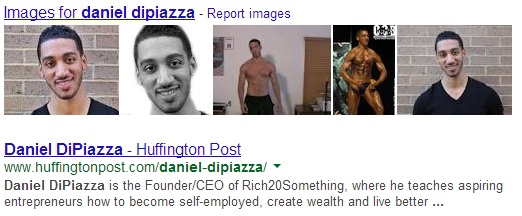
With that being said, here’s how to grab the attention of people you want to write for.
- nothing beats a personal referral. If you don’t know someone at the publication, start a conversation with one of their writers and slowly work your way to giving away some free content…
- …which leads me to: give content away. Send an email with so much incredible, well-put-together information in it, the editor would be silly not to ask you to convert the info into an article.
- and that also segues to another point: it’s never about what you want to write; it’s about what your editor needs in her portfolio. So research your target site and find out the exact content you think they’re missing, then pitch that.
- be prepared to go beyond “writing” and become a true expert. Like I mentioned before, everyone our age is a writer of some sort, so it’s no longer good enough to simply be able to write. Readers want to hear how your unique experience shapes how you perceive interesting stories.
Now, come write for me - please? (oh, and there’s good $$ involved)
Usually, at the end of a post like this, you’d see something like “now please buy my book!” or “click here to watch my infomercial.”
I’m doing it backward.
I want to work with and pay you to write for my new startup. Pay starts at $200/1,000ish word article. If you’re interested, learn more about 75toGo.com and then learn how you can start writing.
Why do this? I mean, $200 isn’t amazing, but it’s a lot more than most places will offer a writer with zero experience. But I’m not looking for writers with experience; I’m looking for awesome young people with unique perspectives and experience, and I believe that that experience is worth paying for.
Oh, and if you’re not interested, a quick share via @rich20something (click to tweet this article) would be much appreciated.
Resources mentioned in this article, plus a few more
Copyblogger
- My favorite article about writing workflow
- Direct link to all their ebooks [I recommend downloading as pdf’s and reading on a tablet]
Books on writing
- Strunk & White [good reference, boring read]
- Stephen King’s On Writing [great motivation and practical advice]
Money
- The Simple Dollar’s clear, simple, and depressing explanation of how to make money writing online.
- A chart on how to estimate book sales from Amazon sales rank. [this is geared toward Kindle, and the baseline shifts from year to year, but I think the logarithmic scale applies and is the real takeaway]
Publishing
- Author, Publisher, Entrepreneur (APE) [this is the one book you must buy if you ever consider writing a book]
- Tucker Max’s article about the future of self publishing [technical, but very good if you can understand what he’s saying. basically, traditional print publishing is screwed, so don’t be afraid to self publish]
- my step-by-step guides and Kindle/CreateSpace templates for self publishing [from a failed startup]
- Chris Guillebeau’s $100 Startup has useful guides on publishing and selling information products as PDFs
I really care about working with this community, especially bright people with zero experience (like I was, very very recently), so I put together some handy-dandy getting started guides:
- Structuring and editing content for clarity and force
- How to interview sources and use quotes, including a pretty clever email template for getting people to respond to you.
[box]
Liked these strategies? Sweet. I can send you some even BETTER stuff. Just join the tribe. (It’s free).


